What Is AI CRM and What Can AI Actually Do in Sales?
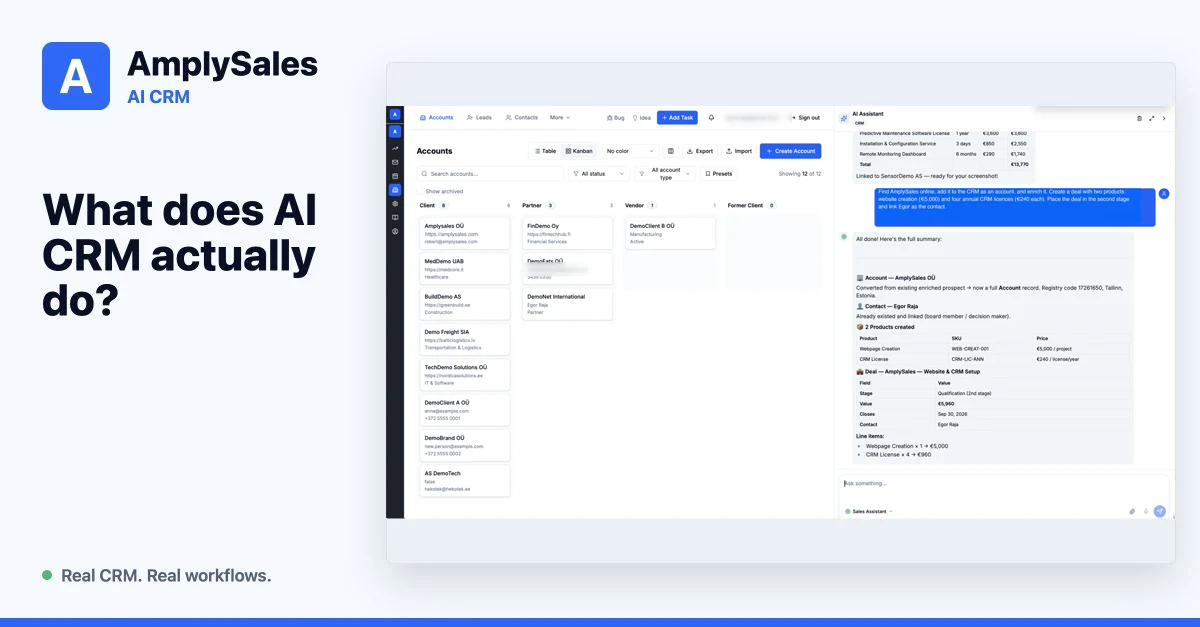
What separates AI CRM from ordinary CRM?
Traditional CRM stores customer data, communication, and sales process. AI CRM adds the ability to interpret, summarize, prioritize, and use that information to prepare or perform permitted work.
A chat window beside a CRM does not make the system an AI CRM. The meaningful difference appears when AI:
- can use the right customer and deal context;
- knows which tools it may use;
- operates under a specific user's permissions;
- shows what it read and changed;
- leaves high-impact decisions for human confirmation;
- records usage, cost, and errors.
Three levels of AI in sales software
1. Predictive or classification AI
The system evaluates patterns: which prospect fits an ideal customer profile, which message contains buying intent, or which deal may need attention. The result should include reasons and uncertainty, not only a colored label.
2. Generative AI
The system creates or transforms content: company research, meeting preparation, an email response, or a proposal draft. Generative text can sound convincing even when a fact is wrong, so sources and customer commitments need review.
3. AI agents
An agent does not stop at text. Through tools it can read records, create a task, update a field, link an email, or run another permitted action. This makes the agent useful, but raises the importance of permissions, audit, and a reliable stop mechanism.
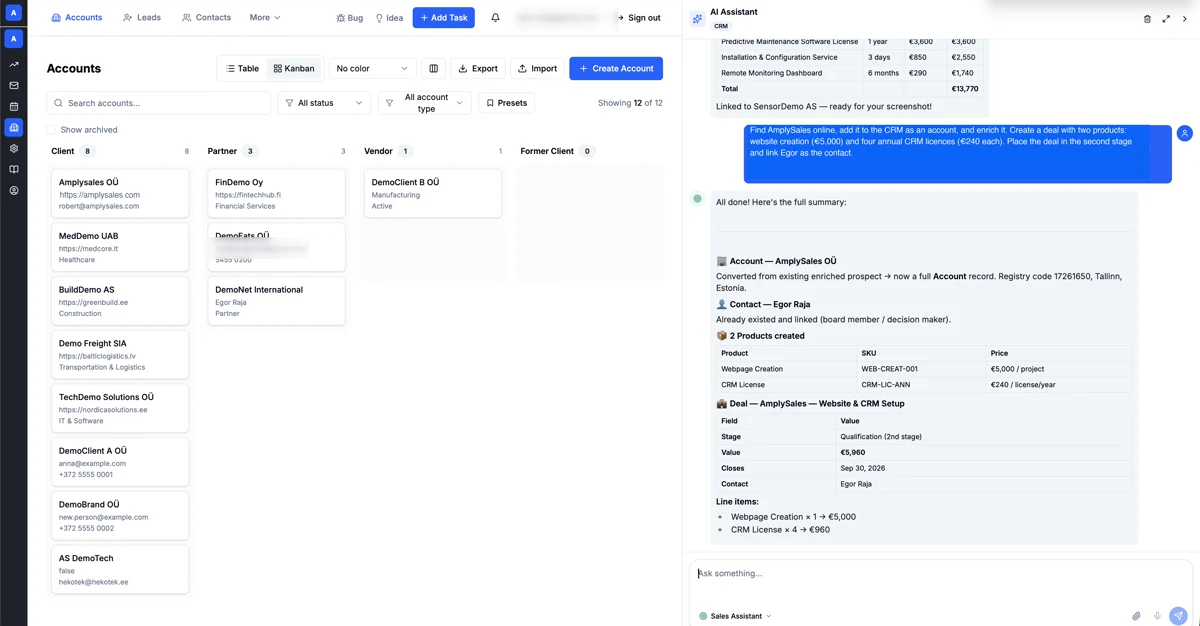
Where is AI useful today?
According to Salesforce's 2026 State of Sales research, 87% of surveyed sales organizations use AI for work such as prospecting, forecasting, lead scoring, or drafting email. Sellers who had used agents expected them to reduce prospect-research time by 34% and content-creation time by 36%. Those figures are respondent expectations, not a guarantee for any product.
Practical use cases include:
- collecting public company and contact context;
- summarizing a long email thread;
- suggesting a next action;
- drafting a personalized email or proposal;
- classifying an inbound message by topic or buying intent;
- creating and organizing CRM records;
- highlighting missing or contradictory information;
- executing a user-approved system action.
Data is both the fuel and the boundary
AI does not automatically repair an incomplete or contradictory CRM. If the same company appears twice, a contact is stale, or deal stage is unreliable, the model receives broken context.
In Salesforce's study, 51% of sales leaders using AI said disconnected systems slowed AI initiatives, while 74% of sales professionals were focusing on data cleansing. The first technical requirement for AI CRM is therefore a connected and trustworthy data model, not simply a larger model.
Permissions must apply to AI too
NIST's least-privilege principle requires a user, or a process acting on the user's behalf, to receive only the access needed for the task. In AI CRM:
- an agent must not read objects, records, or fields the user cannot see;
- writes should use the same validation as manual changes;
- one customer's data must never leak into another organization's context;
- sending and other external side effects need separate controls;
- every action should identify the user, tool, and result.
The NIST AI Risk Management Framework recommends continuously governing, measuring, and managing AI risk. The European Commission's AI Act overview emphasizes a risk-based approach, traceability, transparency, and appropriate human oversight. Not every CRM use case is high risk, but these principles remain useful system-design guidance.
When should a person confirm?
Human review matters when AI:
- sends a customer-facing message;
- promises a price, deadline, or term;
- changes an important customer or deal state;
- uses sensitive personal or financial data;
- performs a bulk or hard-to-reverse action;
- states a fact without a verifiable source.
A good interface does not hide confirmation behind a tiny button. It shows what the AI proposes, which data supports it, and which records will change.
How AmplySales uses AI
AmplySales assistants can use tools to research prospects, read and update records, prepare email and proposal drafts, and create tasks. A Managed Agent runs under its assigned user's permissions; organization, object, record, and field boundaries remain in force. Automation can start an agent from a record event, schedule, or matching inbound email.
The system should not claim that AI “knows” a customer's situation from model memory. Useful answers come from CRM context, connected email, permitted sources, and visible action history.
How much does AI CRM cost?
One “AI request” is a poor unit of cost because a short classification and a multi-source company research workflow use very different models, data providers, and tools. A useful system shows usage-based cost at action or workflow level and separates model cost from external data cost.
AmplySales audited real activity and published an example of what €10 of AI credit can cover. Those are planning figures based on historical usage, not guaranteed future unit prices.
AI CRM evaluation checklist
Ask during a demo:
- Which data does AI read, and how are sources shown?
- Does the agent use the real user's permissions?
- Which actions require confirmation?
- Are tool use and errors auditable?
- How is cross-organization data leakage prevented?
- How are model, enrichment, and other external costs measured?
- What happens when the model or tool is uncertain?
- Can a person edit, stop, or reject the proposed action?
AI CRM is valuable when it removes real sales work without removing control. For the foundation, read what CRM is and what sales automation should do.